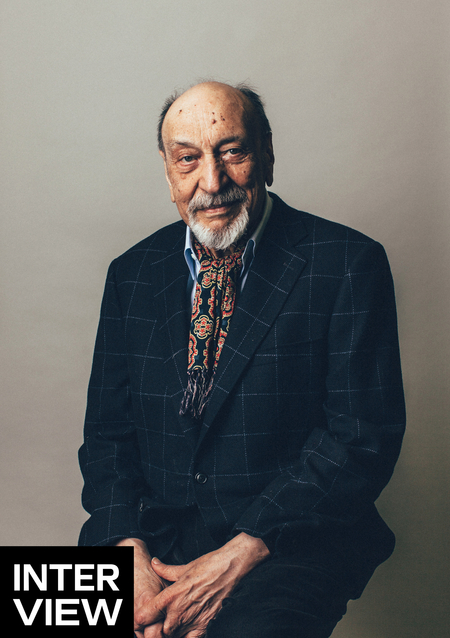
Milton Glaser is a man of legend. For over half a century, his works have been changing the visual image of the world and influencing the development of graphic design. His solo exhibitions were held at MoMA and at the Georges Pompidou Center. In 2009, he became the first graphic designer to receive the US National Medal of Arts. In 1954, in cooperation with Clay Felker, he founded Push Pin Studios, followed by The New York Magazine 1968. In 1974, he opened his own studio, where he keeps working till now. Milton Glazer gave a great interview to The Projector, which the magazine is incredibly proud of.
Mitya Kharshak (M.K.) I would like to start with your early career. You have been in the job for over half a century. Has your attitud to design somehow changed over the years? What would inspire you before and what does now?
Milton Glaser (M.G.) I am often asked about this. Actually, there’s almost nothing that DOESN’T inspire me. I’m very eclectic in my interests. I have a strong desire to understand everything I’m looking at, from a bottle of beer to the Empire State Building. I am though not interested in the object itself but in my ability to look at it attentively, which sometimes doesn’t come easy, but is extremely inspiring.
M.K. Tell me about the first projects you did as a young designer.
M.G. I got my first job at the promotion department of Condé Nast Magazine after I graduated from school: I selected photos and fitted them to page size. I knew very little of what I was doing, but after a couple of months I was able to do it all right. In fact, it was the first and only job when I was an employee. I have worked for myself for most of my life, and I strongly recommend doing so to anyone who is interested in expressing their own ideas. Otherwise, you will be a vehicle to implement other people’s ideas.
Dylan poster. Milton Glaser, 1967 Stevie Wonder concert poster. Milton Glaser, 1968
M.K. Was there a teacher or mentor who guided you at the beginning of your career?
M.G. I had several mentors. The first one was George Salter, an object designer from Germany. He got to the United States after the Nazis came to power. He radically changed the design of the book cover in America. He taught at Cooper Union, and that was he who encouraged me to take this career, for which I am very grateful. With his help, I got into Ellery Queen’s Mystery Magazine, where I had to do covers. I made one — he liked it. But I quickly realized that I couldn’t work in someone’s shadow. I don’t want to belittle its significance: it was a good start. But I couldn’t just reproduce Salter’s manner, so I somehow mustered courage and asked him (I must admit, I was very timid) if I could resign from the job. Unexpectedly, he replied: okay, and we never talked about it again. He was a man of extraordinary intelligence and I understood how important it was for me to find something personal, learn to make decisions of my own, and take responsibility but not just perform tasks.
Big Nude poster for the School of Visual Arts exhibition. Milton Glaser, 1967 Black Foreshortened Nude poster for a solo exhibition at the Museum of Modern Art in Brussels. Milton Glaser, 1976
M.K. Can you point out any milestone projects of your own which brought you international fame? Perhaps the works comparable in scale to The New Yorker Magazine.
M.G. The most significant work I did in my early years was a series of book jackets of Shakespeare editions for Signet Books. This is curious, because in recent years I have started to turn to Shakespeare again. I made about twenty books then, and I did them in a consistent way. I used a very limited color palette, while everyone else who dealt with paperbacks used a lot of bright colors to attract attention. It was worth going into a bookstore, and you were just surrounded by color. And I thought: if the covers were predominantly white, they would be easier distinguished on the shelves. In design, it’s all about context, there is no design without context. If you went into a bookstore of those days, you would see a sea of color, and in the middle of it there were patches of white, which means: Shakespeare’s books are in front of you. This is my first conceptual project, and I did not associate it with an illustration in any way. It was rather an attempt to comprehend totality of desigh experience. The customer was looking for a solution to make the book easier to find. For sure, design is much more than the arrangement of pictures on the surface.
M.K. I can’t leave aside the I Love NY logo. This is one of the most cited visual images of the XX century. Have you ever thought that the fame it brought you outshines the other works by you?
M.G. The success of this work came as a surprise to me, but, when you become known for a singular thing, it usually IS singular. Anyway, this is always an accident, and it’s completely incomprehensible why this or that image gets into people’s heads. I Love NY is not an advertisement, it’s a statement of affection for the city made by its inhabitants. Because of that, it occupies a different place in the brain. We are so susceptible to advertising, persuasion, and other people’s points of view, but here we can see something that really reflects the worldview of a certain community.
In 2001, after the terrorist attack on the World Trade Center, I made the poster I love NY more than ever. I usually compare it to what you experience when someone suddenly gets sick, and for the first time you realize how much you love them, because before you’ve never seen them so vulnerable. The same collective experience gripped New York. So this is not a slogan, not a trademark or a piece of advertising. It was a commitment to an idea that everyone who lives in the city, everyone I knew, suddenly fell in love with the city even more than they had ever realized, and this is how the logo became iconic.
The powerful language of this image also played its role — the heart moves from being a noun to a verb. I substituted an object for a feeling — and this little conversion makes people think for a second, think about what moves the mind.
I Love New York sign. Milton Glaser, 1977
M.K. You have done a lot for New York, in particular, you were one of the founders of The New York Magazine. Did you only work on its design and layout, or were you also involved in the editorial policy and the concept of the magazine?
M.G. Clay, my partner (Clay Felker is an editor and journalist, the co-founder of The New York Magazine in 1968. — ed.), was a kid from the Midwest who wanted to find out how New York works, poked his nose everywhere, leaned out of the window to see what kind of party was going on down there. And I was a kid from the Bronx who thought he knew how to behave in the city. I was interested in cheap restaurants, the downside, and Clay was a visitor basically, looking with astonishment at the place he’d only imagined. And between the two of us, we formed a kind of collective response. And the magazine itself reflects these polarities: from high to low, from cheap to expensive, from the life of the rich to the stories of thre poor and so on. Lots of collective effort is what I think made it. Clay of course was engaged in editorial work with the authors. We had regular meetings and discussions — it was a very collective operation. We had thirty or forty people who worked for our little company, for the magazine, and everyone had a sense of belonging. Each of us wasn’t a kind of mechanic handling the details of the issue, but a co-author who determines the feelings, style and editorial position of the magazine itself.
M.K. You also used the magazine as a sort of personal tribune to express your ideas and your vision of New York. Did you also write texts for the magazine?
M.G. My good friend Jerome Snyder and I ran a very important (although now it may seem trivial) column The Underground Gourmet, which was all about cheap New York. Everyone was looking for cheap food, and there are surprisingly many cheap restaurants in the city, mostly because of the immigrant population. What we did was a transformative event: it was to make going to a cheap restaurant socially acceptable. The middle class doesn’t like it particularly: they perceive it as being dangerous to eat there. Once we began to go to these places, the attitude changed. The idea of transparency came up: you can do anything and anywhere, change the nature of the social relations that existed in the city. That is, such an uncomplicated place as a cheap restaurant can be made significant and change the perception of citizens about the place in which they live.
M.K. How long did The New York Magazine last for you personally?
M.G. Until I left it. About seven years.
New York magazine cover. Milton Glaser, 1968
M.K. Did you have any other long-lasting personal projects?
M.G. There was one very big project — the design of Grand Union supermarkets. An extremely large and complex project that required a whole package of services: interior design, lighting… In this huge project, it was possible to learn retail, sales, marketing — whatever your heart desires, and I learned a lot about it, although I’d never been interested. We worked on this project for five years, and I then got a huge pile of money I could never have earned, being just engaged in graphic design.
M.K. In your career, you have received many professional awards. How important are they to you? Are these generally able to measure a designer’s talent? Do you think young designers should take part in contests, exhibitions and be willing to be awarded?
M.G. Participation in competitions is particularly good for a young specialist: it’s an opportunity to earn a reputation at the beginning of a career, to be independent and to declare yourself. But contests alone are not enough. Talking about your person can result in public recognition, people are looking at a new practician who’s won a reward, and trust them a little bit more. Very often, contests really represent the best of the best, capable of doing high-end things. But it is necessary to participate in competitions first of all in order to make yourself recognized in the professional environment. Contests are in many ways a useful, but not always pleasant experience.
M.K. Your studio is more of a creative workshop rather than a factory. Did you ever think of growing into a large design corporation? After all, there was every opportunity for that.
M.G. Sixty people worked with me when I was engaged in the Grand Union project — the job was very complicated. You need a lot of specialists and resources… I hated it because I was doing management more than anything else. That’s not what I was born for. After I got my cash, I went out of the things, and now I have two beautiful ladies working with me and an assistant, Dan. We all like each other, and it’s a pleasure to work every day.
Angels in America. Poster design. Milton Glaser, 1993 Lord Jim. Book cover. Milton Glaser
M.K. You have worked with a variety of customers — conducted international projects, dealt with big business and cultural institutions. Is your approach to all clients the same or it depends on the professional field of each client? Is working with a museum and working with a bank the same thing?
M.G. This is an ambiguous question which has to be answered carefully, before people imagine what the answer is. Design is always the same, in one sense. First, you need to understand what you are talking about and who the communication is aimed at. I always say there are three components, three legs of a stool: you, the client and the audience. The latter is of the greatest importance, although we would like to think that we are. You can’t be too egocentric here, except when you stand up for what you believe in. But you also have to take into account the needs of the clients, most of whom want to be persuaded to buy something. The need of the audience is to be informed truthfully of what their options are. And you need to express yourself at best without compromising those other needs. So when asked if my approach is the same, I’d say yes — conceptually, no — stylistically. Style is another issue, as well as appearance, coolness and the desire to look somehow there — this all is rooted in the experience of your audience, and that’s another question. Unfortunately, most people, including both teachers and students, consider design to be an external form, style, and identifiable physical characteristic. But design is a much broader issue.
M.K. What do you start your project with? Do you have a system of brain-storming with your colleagues, or do you need some quiet time away from the office?
Surprisingly, my consciousness is an endless stream. Often, when I wake up in the morning, I feel that I have just dreamed a solution for the work I did during the day. I don’t have a separation between thinking and doing. The best way to work is often to begin. So what I usually do is to start working. I don’t do any pre-conditioning exercises for that. Sometimes, while working, I have an idea for next project. That’s the way brain really works. The process of work begins when there is a need to do it. Even during this conversation, I think about how I can finish my work. But the word I can’t stand is brainstorming!
Dog poster. Milton Glaser, for Olivetti, 1969 Sony Tape Full Color Sound poster. Milton Glaser, 1979
M.K. Have you ever been tired? Do you take a sabbatical for six months or a year, just to leave work behind?
M.G. To me, there is nothing more pleasant than sitting at a table and drawing, creating an object or reflecting, this is my life and my pleasure. The traditional idea of a «paradise vacation», when one sleeps on a beach, seems just horrible to me! I’d rather go to jail to avoid this. I am in love with the idea of making things that originate in your mind. It’s like being God (maybe God won’t like it). There is no greater bliss than doing something and watching it come to life, watching in the flesh what you could only partially imagine. When my wife needs a break, we have to go to the countryside every once in a while. But even there I can’t tear myself away from work.
M.K. Are you highly selective in the projects you are offered, or if it’s a good business, the topic doesn’t really matter? Have you ever worked on the projects which didn’t interest you from the creative point of view, but were well-paid?
M.G. In graphic art, everybody faces this universal problem. Designers are engaged in boring, not creative work or cooperate with clients who want to control everything, and there is no room for a designer’s intelligence. I always try to reject any job where I feel there the opportunity for inventions is too limited. Or, more often — when I don’t like the client. I’ve turned down many clients. In this, I am a dictator: if someone talks to me on the phone and I don’t like their tone or voice, I won’t take the job. We instantly know who we can and who we can’t work with, but at the same time we flatter ourselves that cooperation is possible. As a rule, the first impression is enough to make the right decision. I try to turn down every job that has big money but no interest. I have never been able to work entirely for money. And I very rarely refuse the projects which don’t offer enough money, but are of interest to me. So, I’ve been doing a lot of work of social engagement.
Heiwa (Peace) poster. Milton Glaser, 1981 The Joy of Reading poster. Milton Glaser, 1986
Master Studio poster for Fine Art Domberger. Milton Glaser, 1984
M.K. Have you ever had conflict situations when you had to quit the project before it was finished?
M.G. Yes, a number of, but this is when we had a really different perception of a solution.
M.K. Do you take part in negotiations and presentations of your projects? Do you think that a presentaion should be made by the author of the project?
M.G. It basically has to. In fact, I’m the best person to do it, and other studio employees frequently help me with that. They can also do presentations, my colleagues and I have a complete understanding. But every new project has to be proposed by myself.
M.K. So what do you do when a client does not accept the project?
M.G. Every designer will have a whole storeroom of rejected projects which often seem most valuable and meaningful. There are usually several reasons for refusal, but most often these works are very original and go beyond the technical requirements. The necessary requirement is success and, accordingly, accessibility to understanding the target audience. An ambiguious idea can sometimes hardly be sold to a client who just wants to get a compromise option.
When you cannot persuade a customer you have the right project for them, it’s most important not to try to please them or adapt your work to their needs at all costs, because your task is self-improvement. In most cases, you can find a better and more masterful solution. Speaking professionally, the most important thing for you to understand that you don’t have to reduce the quality of your work and do something less memorable and valuable.
Self-improvement is the best working practice you can do when your project is rejected. In this case, you will not spend your life feeling compromising and doing the wrong job. Once again, it’s not always about success.
Cooperstown Chamber Music Festival poster. Milton Glaser, 2013 Cooperstown Chamber Music Festival poster. Milton Glaser, 2012
M.K. You talked about how failures help to move up. Have you ever had a project, the failure of which hurt you so much that you still remember it? Or any other projects not accepted by clients, which you recall with a special feeling?
M.G. I often failed, and when I remember my early works, I realize I couldn’t have done otherwise at the time. I mean I always believe that the opportunity to move up is the greatest good in the profession. If you ask what the most important thing in the job is, I will say it’s your ability to maintain a constant interest in it. When designers lose it, their manner flattens, they begin to repeat themselves, and their projects get weaker and sillier. And, in the end, it turns out that your business no longer enriches your life. You feel frustrated and bored. Since you are unable to maintain an interest in work, you become a busboy cleaning dirty tables.
M.K. Which is more important to a young designer — looking for their own peculiar style and voice, or being a universal specialist able to take up any job?
M.G. It’s a hard one. I’d say it depends on what you want in life. For example, the old model is as follows: if you want to be an illustrator, you learn to draw and develop what is called your personal style, then you are hired because you have this style and no one can do it better than you. This model also works for designers. Unfortunately, many of them do not know how to draw: the skill has been lost because of the digital alternatives to drawing. Drawing is the main way to comprehend the form, and I have always adhered to the idea this is the core of all design. There are people who want to do the same thing all the time. Such work is possible for those who are adapted to this life. I’ve always wondered how far I can go, what and where to learn, how I can learn something I didn’t know before. It means a lot to me. And if everyone around you, even one person, beat you in something, do not strive to be someone other than yourself. Be aware of what you can do. And you’ll find that people don’t expect you to do what you don’t do so well. In the past, I wanted to master the design sections: architecture, lighting, textiles — in my opinion, all these are just parts of one experience that, more than anything else, is conditioned by consciousness.