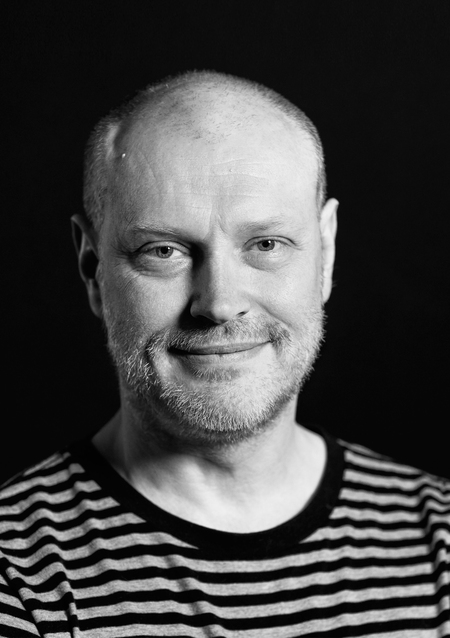
Jonathan Barnbrook is an outstanding British graphic designer. He also works hard in related fields: videography, type design, and teaching. We are delighted to share the interview he gave us when visiting the First St.Petersburg Biennale of Museum Design.
Mitya Kharshak (M.K.) Jonathan, I’ve been watching you work for a long time. But while browsing your website, I noticed a lot of new things — identity, web-design, multi-pages, posters, large graphic complexes. A vast number of people must have contributed to such a result. How many designers are employed by the studio today?
Jonathan Barnbrook (J.B.) We have six designers and one manager. My namesake Jonathan is a senior designer, then there’s another designer, two younger ones and me. We’ve never had more than this, it’s just enough to work on larger projects. But still, the main criterion to appraise a project is the creative interest we have in it rather than its commercial attractiveness.
M.K. Do you personally participate in every project the studio is engaged in, or each project is assigned to a particular colleague?
J.B. We have responsible designers who lead projects themselves, while I am in the sidelines. Sometimes a client wants to talk particularly to me, but my colleagues have been working in the studio for quite a long time, so they know what to do.
M.K. But you do take part in negotiations and project presentations, right? How do you manage to run both creative work and management? Which requires more time and attention?
J.B. Sure, I talk to customers and present projects. Currently, management takes more time. But since I’ve never worked for anyone else, I’m used to running my own studio. I believe management and creativity walk hand in hand — for me, management is part of the design work. Also, I am still working personally on the projects which I find interesting. For example, there are several musicians I enjoy working with — I like them, their music, their energy. And I’m trying to convey that energy in design.
Project: Typography Now Two (book). Client: Booth-Clibborn Editions. 1996
M.K. Are there any clients you would never work for?
J.B. Yes, we have about ten companies of this kind, Coca-Cola or Nike among them.
M.K. Why so? Because of the globalization of their business?
J.B. We have worked a lot for Ad Busters, an anti-advertising organization. It would be strange to collaborate with Coca-Cola after that. You have to be consistent in everything you do.
M.K. You mean, remaining a little designer boutique sounds more interesting than growing into a large conveyor like Wolff Olins or Pentagram?
J.B. When I was a student, I believed Wolff Olins were a kind of antichrists. They do their job well, but that’s not what I’m interested in and what I’d like to do.
M.K. Have you ever had to break up with a client and leave the project unfinished?
J.B. I can’t remember anything like that. Once you’ve started a project, you need to finish it properly. This is a part of project management — not just working in the studio, but also building up partnership with the client. Of course, there are «easy» customers who trust you more than others. But no matter how demanding the customer is, you need to finish the work once you have taken it up.
M.K. You work in close rapport with cultural organizations and museums. From my perspective, these are the most wonderful customers a designer could ever imagine. Who are their opposites — how do you see the most terrible customer?
J.B. It’s not an easy question. As a rule, I have to trust hunches. It’s difficult to work with those engaged in industrial production. For example, is it right or wrong to cooperate with brewing companies? I’d actually like to do something for one. However, we have never designed anything for tobacco companies — they all serve the evil. Considering whether to work on such projects is a hard moral issue that designers should not avoid though. When you start working with a customer, you demonstrate that your client’s business agrees with you. Most designers will say they are just doing their job, or trying to make a living. But it’s worth considering your work at a higher level.
Design doesn’t mean designing only, it is also making the society better. I think a strong point of view is crucial here — we do our work not for ourselves and not for the design community, but for the entire world.
M.K. Where did you study? Do you think your training prepared you well for professional work?
J.B. I graduated from the Royal College of Art. RCA provides self-confidence and acquaintances. There are things you won’t learn at university — it’s impossible to simulate a real working situation. The main thing education gives is the opportunity to find your voice, understand your strong sides and the vector of further improvement. As for me, design education puts too much emphasis on job search. I think we need to think more broadly — does design improve our society? Are we doing a good or a bad thing? The most frequent question I get from students is ‘How will I get a job? There’s a lot to happen in your life, you will probably make mistakes, but it’s likely you’ll finally end up on the right way. I think education has become too focused on the industry. Anyway, it’s understandable — people often get into debts to pay for education.
M.K. Do you remember your first commercial order?
J.B. It seems to have been a book cover. It was trouble finding orders when I was studying, but I knew that I needed very little money to survive. I guess people often head off a chosen course because the economy tells them to get a job. It probably won’t be the right job and you won’t have to do exactly what you want. You need to be very careful in such compromises. They can very easily lead you off the right path.
M.K. After graduating from college, did you work as a freelancer, or you were employed by a big design studio?
J.B. I shortly worked part-time for different companies, two or three working days a week. It was just necessary to earn money. At the same time, I had my own commissions. As soon as I was able to start seriously working for myself, I did so, and each new work brought me new commissions.
Newspeak (book). Client: Saatchi Gallery. 2010
M.K. Can you name the masters of art and design who influenced you during your studies and professional work? Who do you really admire?
J.B. It turns out these are mostly not graphic designers. Russian constructivists and supremacists really had a great influence on the whole world. They worked at the time when graphic design was invented in the way we know it today. Their works have an amazing combination of politics, science, technology and aesthetics. They would fill their works with what they sincerely believed in.
M.K. And how about graphic design, our contemporaries, colleagues who work today?
J.B. In fact, I’m not very much into graphic design, so I simply don’t know them. I don’t collect graphic design neither monitor the industry. I think I’m much more influenced by things like music. We’ve sent projects to competitions a couple of times and have also taken part in poster biennales. But basically, I don’t tend to take part in professional competitions and exhibitions. You can come across much more interesting graphic design in the streets — there are a lots amazing things.
Barnbrook Bible (book). Client: Booth-Clibborn Editions. 2007
M.K. Speaking of British design, can we say that it has its own voice today? Does it have features that distinguish it from other significant national schools? We all know the Polish poster of the 1960s and 1970s or the Swiss school. What is British design?
J.B. Yes, British design has its own specific features. The fact is that modernism has never become a significant part of the history of the UK society. It surely had lots of aspects, but it did not manifest itself so significantly as in the history of Germany, Switzerland or Holland. Modernism has not had such an impact on our design as it did in Western Europe. I’d rather say, there was a counter-reaction to modernism in British design as it was seen as a threat. For example, I personally considered Helvetica as not a British type at all, it seemed wrong to me. Today’s designers are largely influenced by the history of the underground, its graphic and type language. The visual culture of Britain is different from what other countries have.
M.K. Can we say that punk culture has influenced British graphic language? And can we assume that punk manifested itself in the works by David Carson later on?
J.B. I think David Carson is the one who manifests freedom, while punk is more about destruction. I think these are very different worldviews.
M.K. But his The end of print concept is also about destruction.
J.B. I think Carson was an intellectual, and punk wasn’t an intelligent culture. It was an uprising against the upper class and those in power, despite the fact it was joined by middle class as well. These are completely different things. Punk entirely changed the British society.
Poster from the visual identity of the 17th Sydney Biennale. 2010
M.K. Today you work with clients from a variety of countries. Do you see any problems in communication with them? Have you ever had a culture clash? Have any culture differences ever made your work harder?
J.B. Well, it depends. For example, it is very difficult to work with a different alphabet. We’ve recently been doing a big project in Ukraine — we had to tackle Cyrillic. We’ve also worked with Japan — we had to deal with hieroglyphs. By and large, it all depends on the people we interact with. For instance, Japan has a weird trend to worship some designers as great masters. You can know a lot about different cultures, but you can’t come there and turn into a Ukrainian or Japanese. I believe this is why we re invited into foreign projects — because we are different, and our graphic language is different from the local one.
M.K. We’ve already mentioned the difference in approaches — a little design bureau and large agencies. But what are the advantages of a little studio in the global world market?
J.B. You don’t have to work just for money. Of course, we sometimes have to do this to pay salaries, but it does not mean we take on any order just because it pays well. Personal contact would be another advantage. Everyone in the studio knows each other, same with clients — we communicate on equal terms.
Arsenale 2012 poster. Client: Mystetskyi Arsenal. 2012 Poster from the visual identity of Mori Art Museum. 2003 Arsenale 2012 poster. Client: Mystetskyi Arsenal. 2012
Regime font. Virus fonts. 2009
M.K. When talking to Stefan Zagmeister, I heard about his practice of taking a year off every seven years. He completes all the projects and goes to travel the world. Do you do anything to keep your mind clear and thoughts fresh?
J.B. I think I’ve never been on a real vacation. I just don’t need it. I am never bored and do not strive for an additional source of inspiration. The time we live in is incredible by itself. Well, even when I do go abroad, it’s all for the sake of creative work. I don’t need a vacation. I compose music, I’m interested in music, maybe that’s what my release is. But in fact, this is all from the same source, both design and music — they are just the manifestations of the same entity.
M.K. I was going to ask about other fields of activity, but you outstarted me and mentioned music. Is there another field you’d like to do something in?
J.B. I would like to do architecture if I have a chance. However, a customer who allows you to do something different from others is quite a rarity in any field. Anyway, I would really like to design building spaces. Maybe I should put more effort in here. We are gradually starting to design exhibition spaces already. Designing a building is an intellectual statement!
M.K. And a piece of architecture work is highly likely to outlive any graphic work! We work with short-lived items.
J.B. Right. A graphic work has no real value, it is ephemeral, while a building is an entirely different thing. Its similarity with graphic design is that you enter someone’s universe and create a visual language people understand it and interact with. And this is what attracts in the design of the space. This is really a very exciting field.
M.K. Is there a dream project you would like to implement?
J.B. Yes, I would like to create a visual universe — a project where I would have full control over the space to design a building, interiors, graphics. Even more — to come up with a concept and reasons why such a building should be constructed.
Typeface Sarcastic. Virus Fonts. 2007
M.K. How do you see the future of design in ten years? What are we going to do in 2025?
J.B. Graphic design is a very broad field. There are commercial and non-commercial designers. Since I became a graphic designer, the profession has been getting more important and socially beneficial. Designers should be responsible for what they bring into this world. And, of course, technology has always influenced design — from the very first printing press to today’s smartphones.
M.K. You started off in the pre-computer era.
J.B. Yes, I graduated from college in 1985. The early 1990s witnessed the new computer typography develop super rapidly. It was very interesting — same as when electric guitars appeared in music and people started doing something unseen before. Suddenly, typography became the job of the young, not the senior, as it used to be. Unfortunately, I don’t tend to follow trends in graphic design. There’s always an overtone of fashion in it. I would never do the job just to get into some current trends. I work because I put some intellectual content into the project. I believe it is important not just to think about how to make a project, but to constantly ask yourself why you are doing it this way. This is probably not the answer to the question about the future. But this is personal future. Undoubtedly, we are becoming too commercial. I dream that designers have a large selection of interesting projects. Doing work just for money is boring.
M.K. And the last one. What can you say to young designers who are now finishing their studies and entering the profession? They have so many opportunities in technology and communication.
J.B. You need to do what really fascinates you. When I look at a portfolio, I’m not interested in a universal designer able to create whatever they’re asked for. I want to see someone special, better than everyone else, and really interested in what they are up to. This is the best portfolio. It’s important to be honest. Make your job a part of your worldview, do what you are interested in. In my opinion, these are obvious things. But many people still think that you need to do design to get a job. Maybe the path I offer is harder, but you will be happier in the end. And this, after all, is the goal of our life.